Hello my friend,
One of the most frequently encountered (and often misused) logical fallacies: the Ad Hominem fallacy.
Ad Hominem is a Latin phrase that translates to “to the man“ or “to the person.” This fallacy occurs when someone tries to refute an argument by attacking the character, motive, or other attribute of the person making the argument, rather than attacking the substance of the argument itself.
The core problem is that a person’s character, circumstances, or personal history has no bearing on whether the logic or evidence presented in their argument is sound.
How Ad Hominem Works
A valid argument should stand or fall on the strength of its premises and evidence. The Ad Hominem fallacy attempts to shift the focus away from that evidence and onto the person. It follows this basic flawed structure:
- Person A makes claim X.
- Person B attacks Person A (e.g., calling them names, questioning their motives, or pointing out a flaw).
- Therefore, claim X is false.
Classic Example
Imagine a debate about new traffic laws:
Speaker A: “I believe the data shows that installing a traffic light at the intersection of Elm and Main will significantly reduce the number of accidents.”
Speaker B: “Of course you’d say that! You were cited for speeding just last year. We shouldn’t listen to a speed demon about traffic safety.”
- The Argument (X): Installing a traffic light will reduce accidents.
- The Attack: Speaker B attacks Speaker A’s past driving offense.
- The Fallacy: Speaker A’s speeding ticket has no logical connection to the validity of the accident data or the effectiveness of a traffic light. The data must be evaluated independently of the speaker’s personal life.
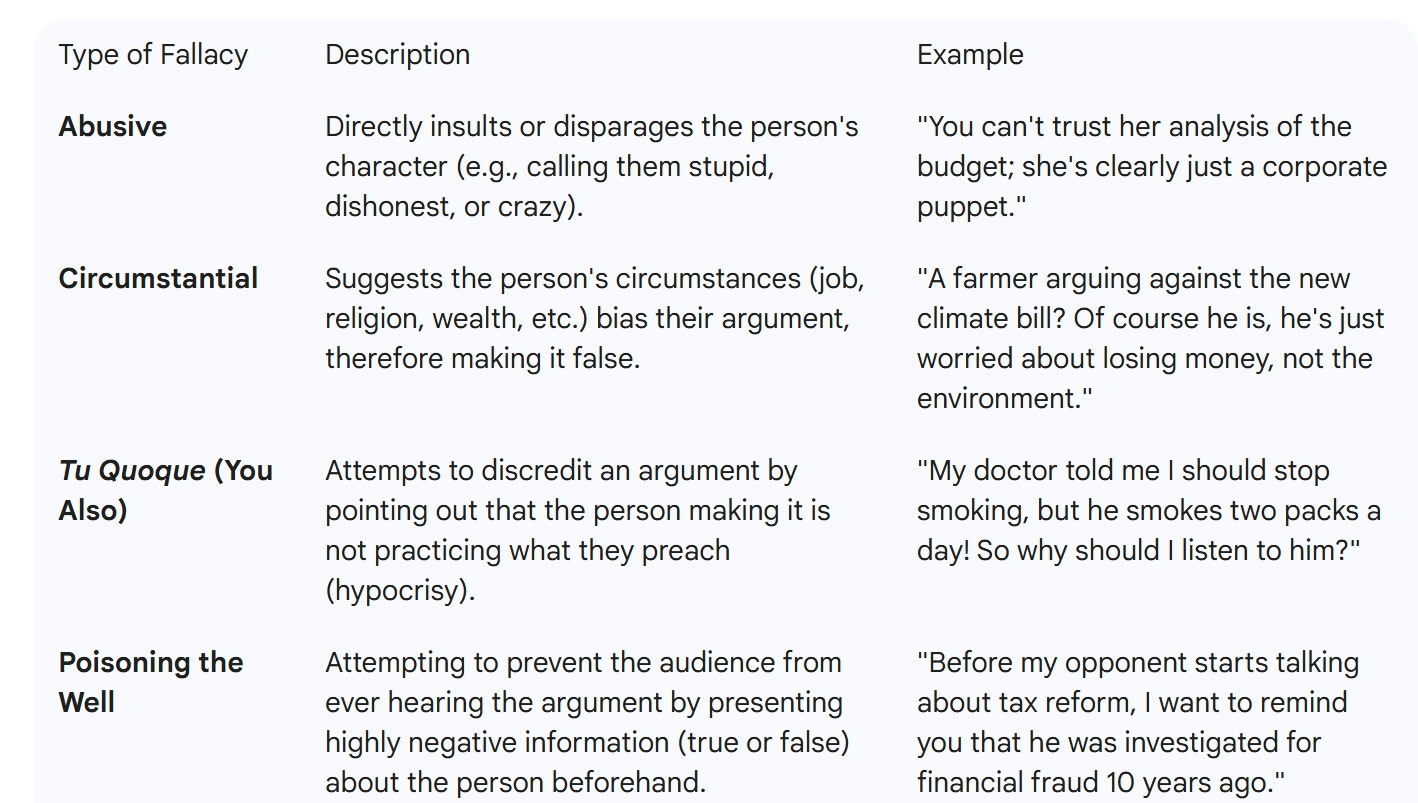
The Four Main Flavors of Ad Hominem
The fallacy isn’t a single, uniform attack. It comes in a few distinct types:
Why Does It Matter?
Recognizing and avoiding the Ad Hominem fallacy is crucial for productive discussion:
- Focus on Truth: It forces us to focus on the objective truth, not on personal feelings or biases. A good idea is a good idea, no matter who proposes it.
- Respectful Debate: It keeps arguments civil and respectful, preventing conversations from devolving into personal attacks.
- Critical Thinking: It sharpens your critical thinking skills by training you to separate the speaker from the content of their speech.
The Golden Rule: When evaluating an argument, always ask yourself: Does the personal attribute being attacked have any logical relevance to the truth or falsity of the claim being made? If the answer is no, you are likely witnessing an Ad Hominem fallacy.
QUOTE FOR YOU
When the debate is lost, slander becomes the tool of the loser." — Socrates
QUESTION FOR YOU
See question above
JOURNAL PROMPT FOR YOU
If you encounter an Ad Hominem attack in the future, how will you respond to redirect the conversation back to the substance of the argument without getting defensive or engaging in a counterattack?
ARTICLE FOR YOU
VIDEO FOR YOU
SOMETHING FOR EVERYBODY
I do a podcast called Something for Everybody, listen here.
This week’s upcoming episodes:
Tuesday - 12/23 - Anthony Cudjo
Friday - 12/26 - Year End Reflection
Lots of love,
Aaron
Shop my clothing brand here
PS Drop a review on Spotify or Apple.
How To Do The Work With Your Mental Health (E-Book)
$9.99 USD
Taking the first step toward improving your mental health can feel overwhelming, but it’s also the most powerful one you can make. In a world that often demands more from us than we can give, it’s easy to neglect the foundation of our well-being: our mind. This eBook is designed to guide you through seven crucial areas that, when addressed, can help you begin the work of strengthening your mental health. Whether you're just starting out or looking to dive deeper, these seven key areas will help you build a more resilient, balanced, and empowered mindset—one small step at a time. Available to download after purchase!